Pillar 1
Basic & Special Education
To build on the NUGS Basic School Infrastructure and Support Projects, accelerating real, measurable progress against Ghana's schools-under-trees crisis and strengthening NUGS's role as a national advocate and partner for inclusive basic and special education.
Current challenges & evidence
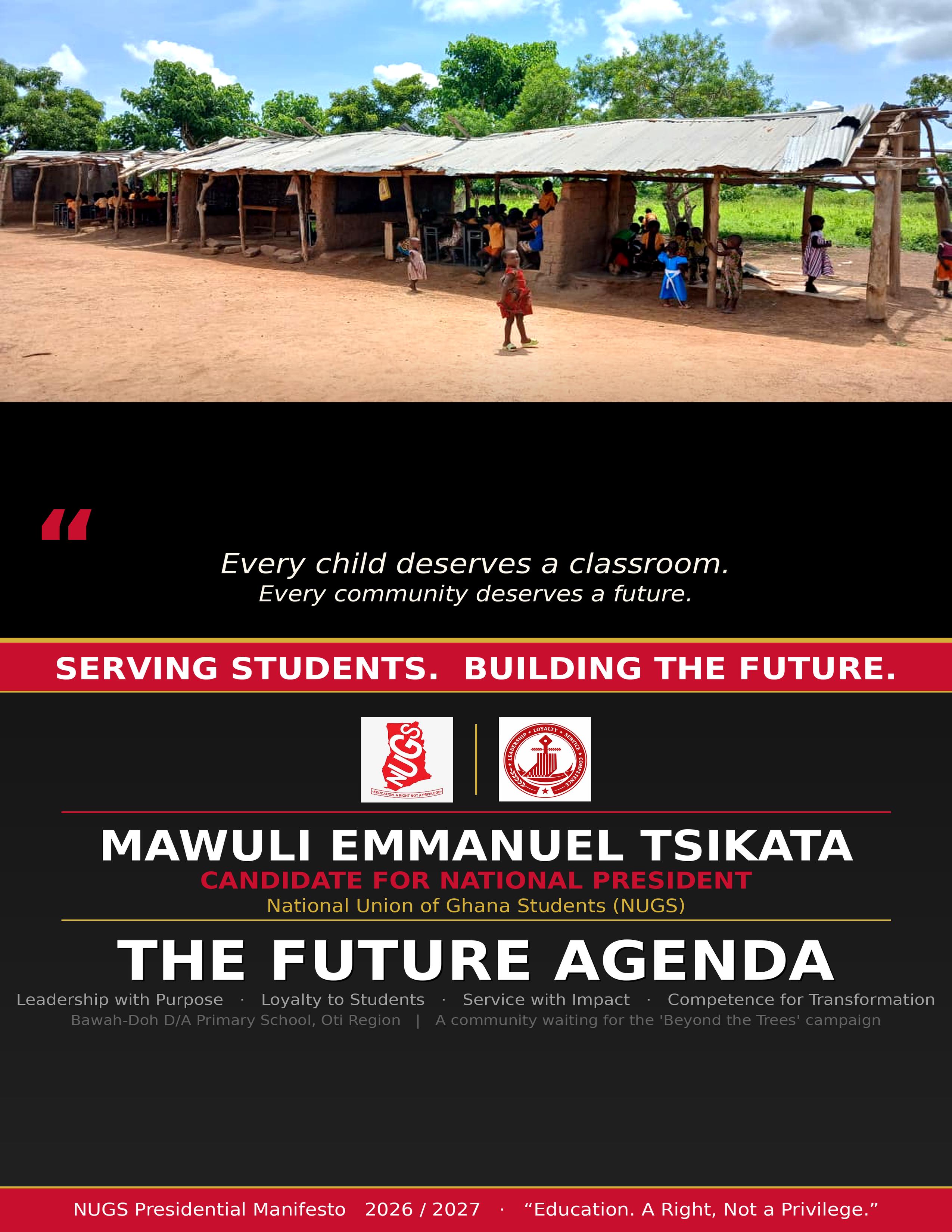
- Over 5,400 basic schools nationwide still operate under trees, sheds or dilapidated structures, with roughly 80% concentrated in the northern regions, Western North and Oti.
- Approximately 1.2 million children aged 4 to 17 have never attended school, and an estimated 147,000 pupils (about 30 per day) drop out annually, disproportionately from deprived communities.
- Basic education's share of the Ministry of Education's budget fell to about 20% in 2023, down from 39.2% in 2019, despite carrying the largest student population.
- Special education learners, including children with visual, hearing, physical and intellectual disabilities, remain underserved, with limited specialist teachers, assistive devices and accessible infrastructure, particularly outside major towns.
- The existing NUGS Basic School Infrastructure Project (a 6-unit classroom block model) and Basic School Support Project (learning materials, uniforms, footwear) have proven impactful but operate at a scale far smaller than the national need.
Proposed solutions
- Relaunch and scale the NUGS Basic School Infrastructure Project as 'Project Foundations', a multi-year classroom block programme targeting deprived communities, prioritising the Northern, Savannah, North East, Oti and Western North regions identified as carrying the heaviest burden.
- Establish a formal liaison desk between NUGS, the Ghana Education Trust Fund (GETFund) and the Ministry of Education to track disbursement of approved basic education infrastructure funds and publicly report on progress, in support of the GHS 800 million 2024 allocation and subsequent budgets.
- Expand the NUGS Basic School Support Project (exercise books, textbooks, uniforms, footwear) through partnerships with corporate sponsors, alumni networks and diaspora blocs, targeting at least one additional deprived district per region per year.
- Create a Special Education Partnerships Desk within NUGS to coordinate with the Special Education Division of the Ghana Education Service, the Ghana Federation of Disability Organisations (GFD), UNICEF Ghana and the Ghana Blind Union, to map gaps and channel student-led advocacy and resource mobilisation toward inclusive classrooms, assistive technology and teacher training.
- Mobilise tertiary student volunteers (through SRCs and NUGS local chapters) for structured community outreach, literacy clubs, mentorship and donation drives, in adopted deprived basic schools, building a direct, sustained relationship between tertiary students and the basic schools their fees and taxes support.
Implementation strategy
- 01Within the first 60 days, conduct a national needs-mapping exercise in partnership with the Ghana Education Service to identify and prioritise the next 10 communities for Project Foundations classroom blocks.
- 02Within the first 100 days, sign at least two new partnership memoranda, one with a GETFund-aligned government agency and one with a private-sector or diaspora sponsor, to fund the first classroom block under this administration.
- 03By month six, establish the Special Education Partnerships Desk, complete a baseline assessment of three pilot institutions, and launch the first assistive-resource donation drive.
- 04By month nine, expand the Basic School Support Project to at least five additional deprived schools through SRC-led 'Adopt-a-School' partnerships.
- 05By month twelve, publish a public progress report detailing funds raised, classrooms completed or under construction, and learning materials distributed.
Expected outcomes
At least one new classroom block initiated or completed; expanded learning-materials support reaching additional deprived schools; a functioning Special Education Partnerships Desk with at least one active assistive-technology or training initiative.
Key performance indicators
Number of communities assessed; number of partnership MoUs signed; number of classroom blocks initiated/completed; number of schools receiving learning materials; number of special-education partnerships established.
Timeline
Months 1 to 2: needs mapping. Months 3 to 6: partnerships signed, Special Education Desk launched. Months 6 to 12: implementation, monitoring and public reporting.
Monitoring & evaluation
Quarterly progress reports published on NUGS digital platforms; site visits by the National Executive Council; independent verification by partner agencies (GES, GETFund) at project milestones.
Risk mitigation
Funding delays mitigated through phased, milestone-based partnership agreements; community resistance or land disputes mitigated through early engagement with traditional authorities and District Assemblies; capacity constraints mitigated by leveraging existing GES and partner-agency project management structures rather than duplicating them.
Have your say
Comments on the manifesto
Read the pillars above, then tell us what you think. What would change your campus? What did we miss?
Loading comments...